The Buffyverse
Or, Welcome to the Bronze

Today, March 8, is International Women’s Day. Yesterday I was briefly on LinkedIn, and the site suggested I write a post about a woman who was important in my career. I chose to write about Lisa Clancy, the editor at Simon & Schuster who had an enormous impact on my career writing fiction.
My first novel, as I’ve mentioned, was Gen13: Netherwar, on which Christopher Golden and I collaborated. When I turned out not to be a total disaster, Chris introduced me to the editor for his Buffy the Vampire Slayer novels, Lisa Clancy. Lisa was looking for someone to write a novelization of three episodes focusing on Xander Harris, and she asked me to take a crack at it. I did, and that was the beginning of a long and fruitful relationship.
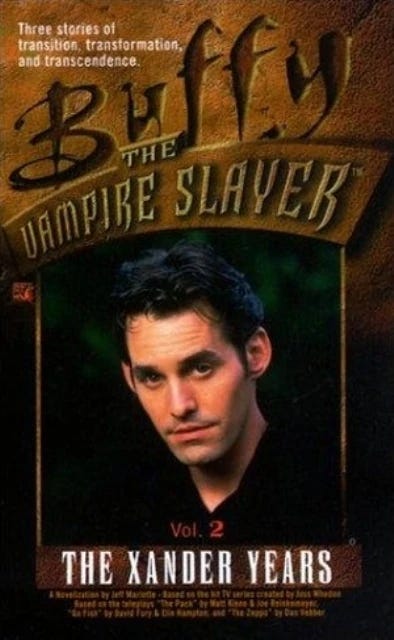
I hadn’t actually been watching Buffy before that. I was aware of it, and knew many people who were diehard fans. I’d seen the Buffy movie, which I thought was entertaining, but I felt like the concept was a little one-note. “Hey, what if a cheerleader fought some vampires?” I thought it was a bit demeaning, in fact—take the most stereotypical teenage-girl role—cheerleader—and turn it into a gag.
Obviously, to write the book, I had to watch the episodes and read the scripts. I did both, and found that Joss Whedon was taking a different approach on the show than he had in the movie.
(Full disclosure: when the news about Joss’s treatment of some of the women in the cast, most notably Charisma Carpenter, came out, I saw the original movie through a different lens, and suspected that it was the truer depiction of his attitude toward women than the series. I mentioned this publicly, supported Charisma’s efforts, and was interviewed by a reporter who did a major magazine piece about it. I had only my own impressions of Joss through his scripts and some limited personal interactions to describe, so my comments weren’t used in the piece. But I freely admit that Joss is not my favorite person.)
Anyway, I found more to like in the series. The scripts, by a crew of terrific writers, were engaging and sometimes a great mix of hilarious and spooky and the cast was brilliant.
But some other writers, most of whom were also friends, were already writing Buffy novels. Fortunately, the Buffy series launched a spinoff called Angel. And Angel was a vampire who was also a private detective! I’d been reading PI fiction for most of my life, starting with the Hardy Boys, Encyclopedia Brown, Emil and the Detectives, and graduating to Raymond Chandler, Dashiell Hammett, Ross Macdonald, Robert B. Parker, Stephen Greenleaf, Joseph Hansen, Sue Grafton, Robert Crais…even longer than I’d been reading horror. But I was well-versed in both genres, and this was right in my wheelhouse!
Lisa agreed to let me take a crack. Pal Nancy Holder had written the first two, but I wrote the third, Angel: Close to the Ground. (The title came to me at a Willie Nelson concert I attended while plotting the book, when Willie performed his great song “Angel Flying Too Close to the Ground.”)
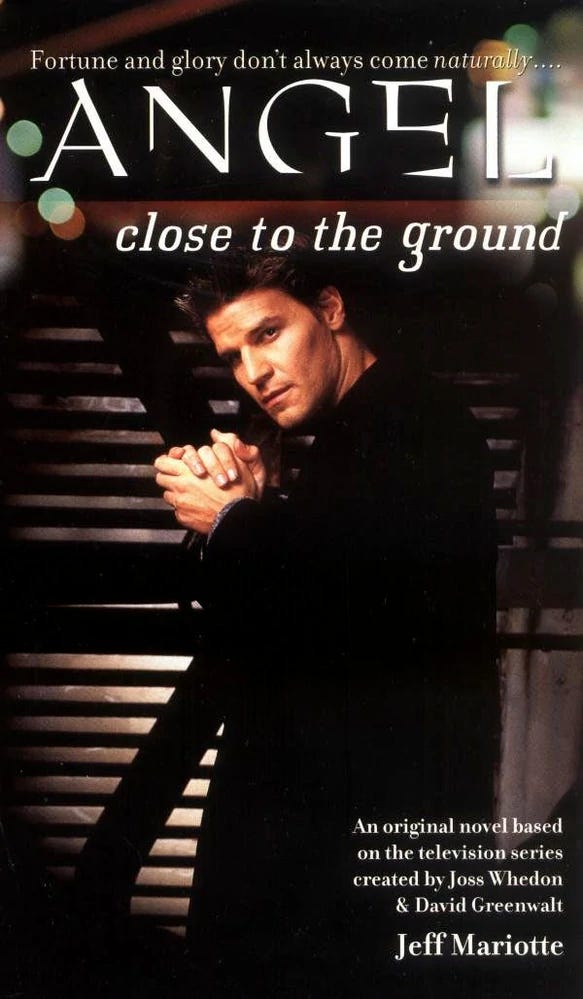
I liked it, Lisa liked it, and the fans seemed to like it, so I was allowed to keep going. By the time the series ended, I had written 11 Angel novels, four of them—the Unseen trilogy and Angel: Endangered Species in collaboration with Nancy Holder. Unseen was a Buffy/Angel crossover trilogy, and Endangered Species was the first Angel novel to be released first in hardcover. I’m actually not sure if it was ever released in paperback.
My 11 novels made me the most prolific Angel novelist by far. But I wasn’t done.
The TV shows were the basis of a large part of my novel output in those days (and Angel is still the series of books I’ve written with the most entries), but the shows were more than just television entertainment. They created a community. Buffy and Angel fans gathered around the world to celebrate together their love for those characters. Although the shows have been off the air for decades, there are still occasional conventions where the fans come together.
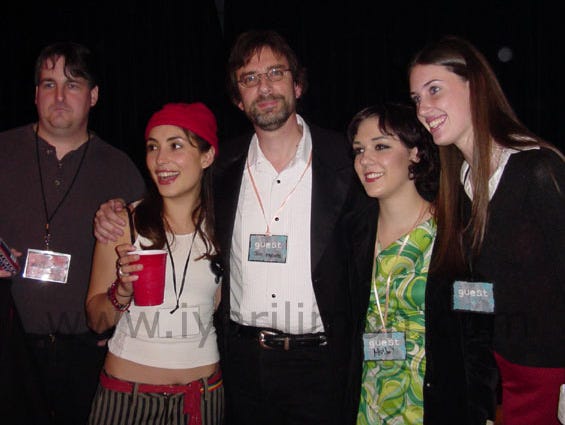
There were also parties, including some in Hollywood, at which cast members and even Joss got together with their fans. I didn’t go to a lot of those, but I went to one or two and met several cast members there, including Iyari Limon (Kennedy) and Sarah Hagan (Amanda). Here they are with my daughter Holly between Sarah and me, and another fan (whose name I forget, sorry!) on the other side of Iyari.
Those are far from the only cast members I met, some of whom became good friends. With Nancy Holder and my then-wife, I wrote the second Buffy Watcher’s Guide and the first Angel: Casefiles, behind-the-scenes nonfiction episode guides, chock-full of interviews with casts and crews. To write those, we had to spend time on the respective sets. I was able to go along to the Buffy set, where I watched scenes being shot, stunts being done, actors in makeup (I saw a shirtless James Marsters [Spike] get an arrow placed in his chest, and learned that we wore the same size jeans—and even if they were monogrammed, we could swap because we’re both JMs). I saw Sarah Michelle Gellar fighting a terrible cold, coughing and sneezing and stuffed-up—but when the camera rolled, she was strong, capable Buffy Summers, and you’d never know she was very sick. We interviewed writers and drivers and set designers and makeup artists and people in just about every conceivable role, and we watched every episode and made extensive notes so we could accurately describe them.
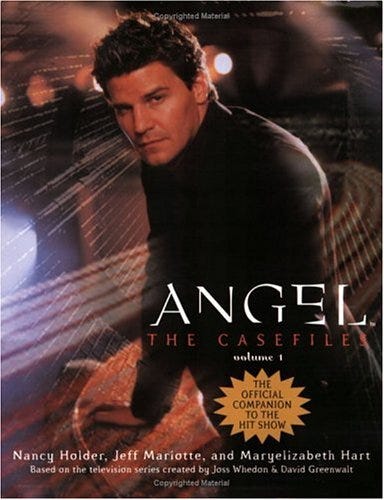
I didn’t get to go along to the Angel set because I was busy with other things. But I was otherwise heavily involved with that book as well.
I also met cast members at conventions, at dinners, and other occasions, and became close friends with a few. I’m still in touch with James Leary (Clem) and Juliet Landau (Drusilla) and Amber Benson (Tara), who interviewed me for my spotlight panel at the San Diego Comic-Con the year I was a special guest and was given my Inkpot Award. I got to watch Andy Hallett (Lorne) sing Lady Marmalade at a karaoke party at a con (he was brilliant, and gone much too soon). I attended a con in London with a ton of cast members, including Tony Head, and the trio of Danny Strong, Tom Lenk, and Adam Busch, among others, and got together with them stateside as well.
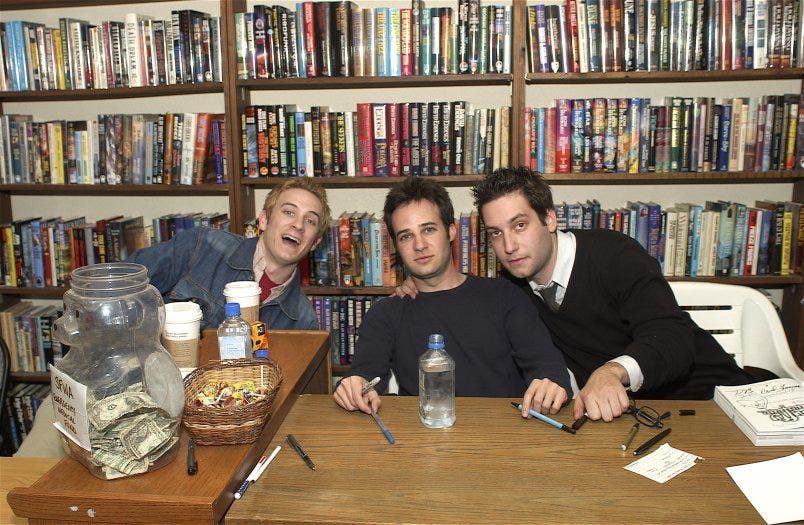
That experience demonstrates the occasional pitfalls of attending cons. To begin with, it was very strange, compared to U.S. cons—very structured. All of us—cast members, crew members, and writers like me—were seated at long tables in a narrow space. Fans were admitted in single file, and they streamed past the tables, stopping at the ones where they wanted autographs on objects they brought in with them. There was no dealer’s room per se, just a small room with merch—books, DVDs, and photos, mostly, in which cans could buy the stuff they wanted signed before they filed into the room. There were also rigidly controlled photo sessions (which were pretty pricey), and some of the guests had speaking slots on a stage.
The con’s promoter had paid for coach-class air tickets to London and back for me, my then-wife, and our son, and for a nice room at the convention hotel. Other arrangements, including fees, were arranged for the cast members. But on the last morning, when we all headed down to check out of the hotel before flying out, we discovered that the convention’s promoter had skipped town with all the proceeds. Before paying the hotel bills. My room for the three or four nights I was there came to about $1600. Those actors who were owed appearance fees didn’t get those, either.
I was lucky in that the flight home had already been paid for—and luckier still in that, when checking in at the airport, the clerk said she had three unsold seats in first class, and if we wanted them, they were ours. So instead of flying back to the U.S. in coach, we spread out in luxurious first-class accommodations. It makes crossing the Atlantic considerably more comfortable.
I started out talking about Lisa Clancy, who acquired and edited all those Buffy and Angel books, which were the bulk of my output and the time and the basis of my career writing tie-in fiction. But her contribution to my career goes far beyond that, because she also bought a young-adult horror quartet I pitched her, which came to be called Witch Season. The four books were titled Summer, Fall, Winter, and Spring, and involved (among other characters) a witch named Season.


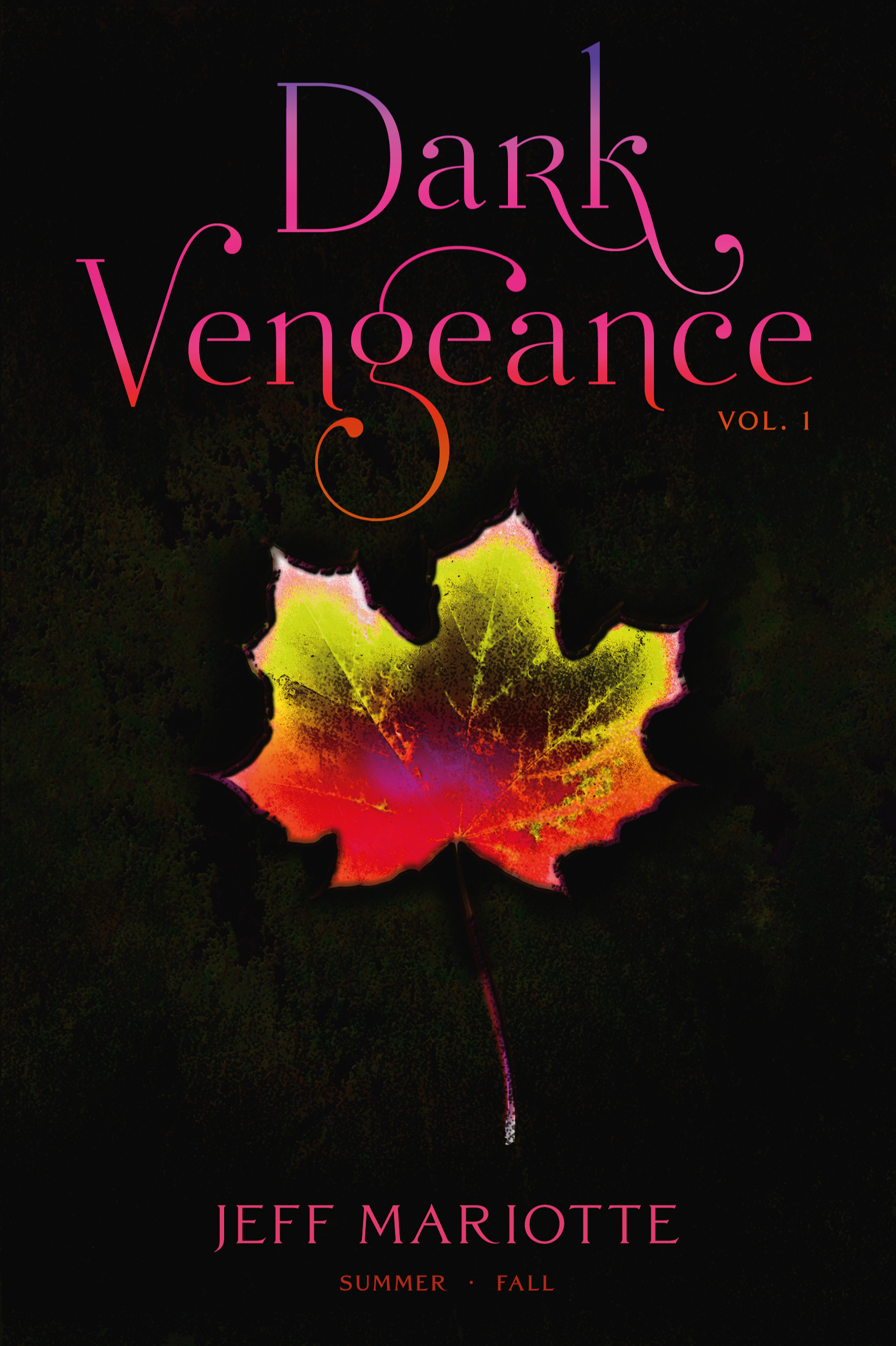
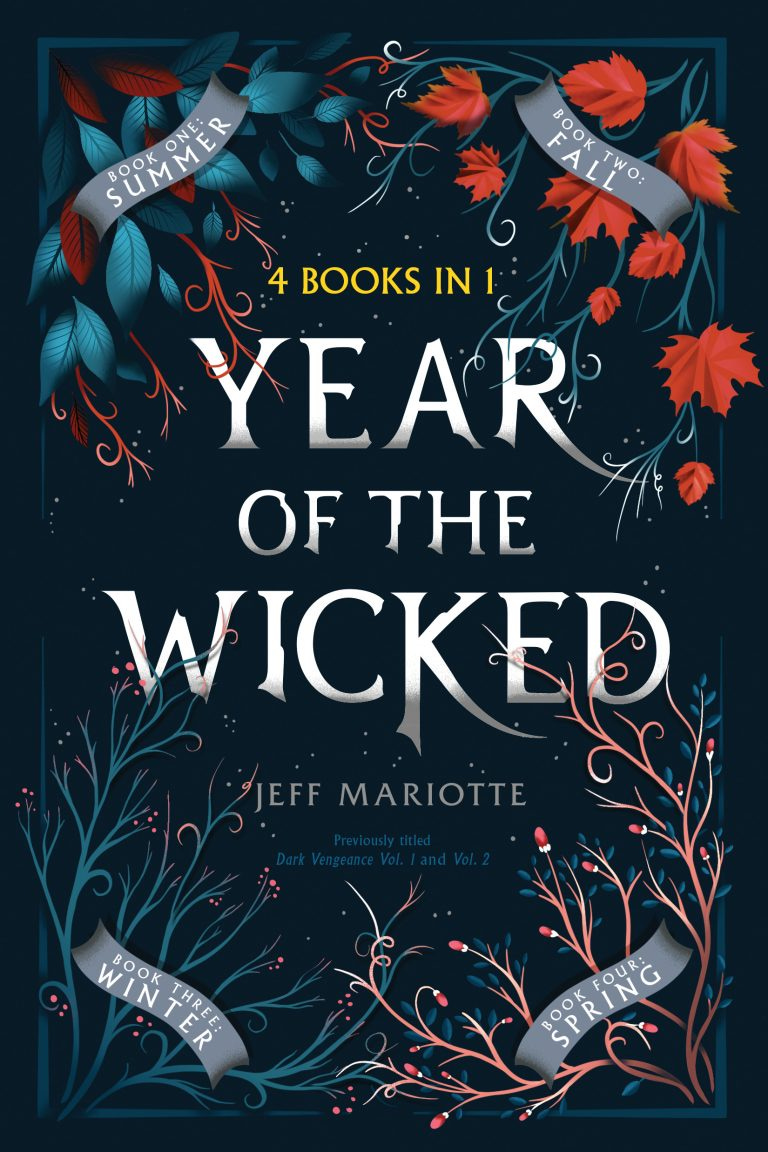
Simon and Schuster did well enough with these books that they kept putting them out in different editions. There was a Barnes & Noble exclusive edition in two volumes, then a general two-volume edition, both called Dark Vengeance. Then there was a single-volume edition collecting all four books into one, called Year of the Wicked.
Per the Simon & Schuster website, all of these—four volumes, two, one—are still in print and available.
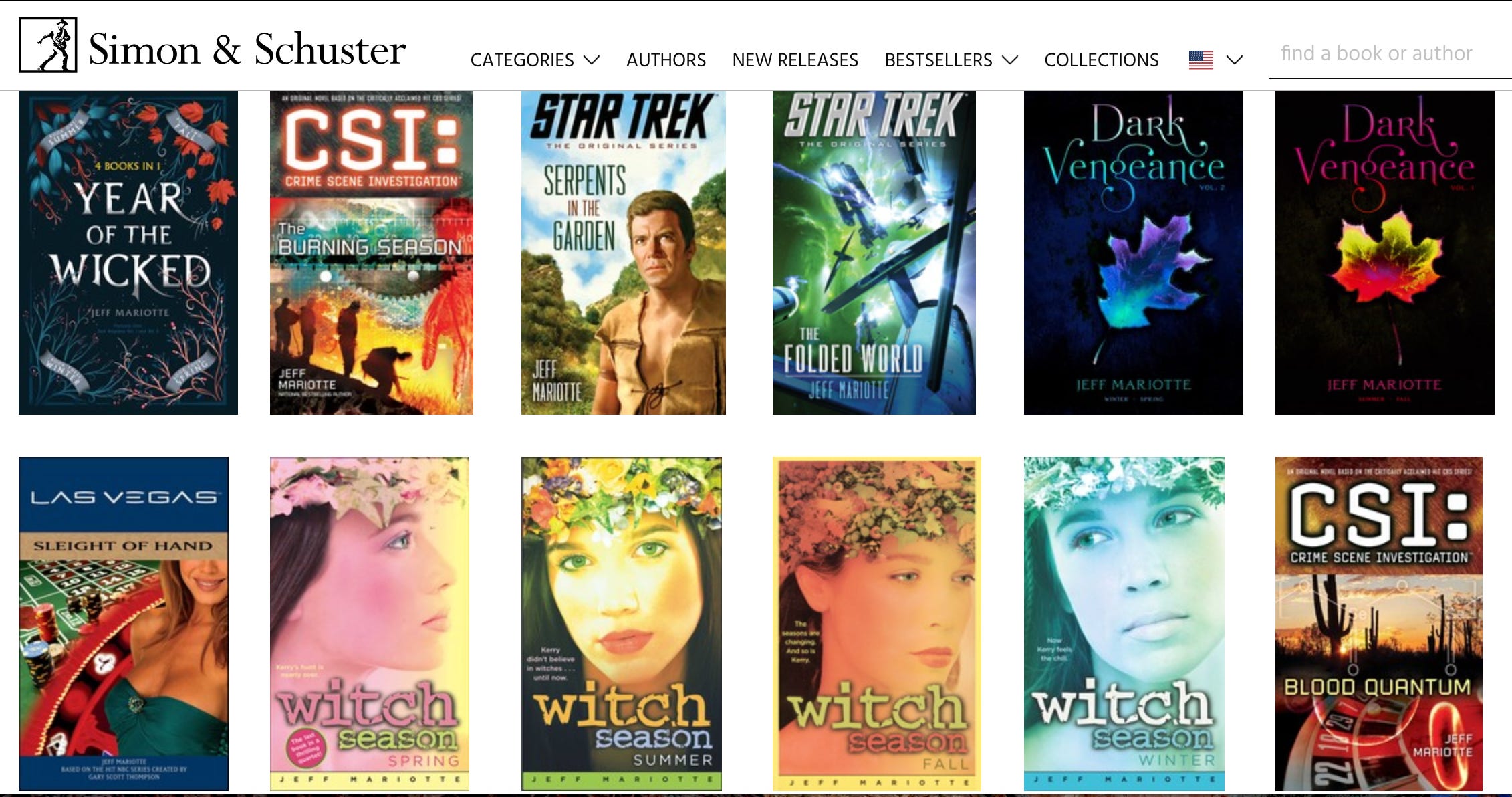
Together these books have paid me more in royalties than any other book I’ve written (though I think some comics, from the boom days of the early 90s, still beat these out). And they’ve won me legions of readers. When I moved to remote Cochise County, AZ, I met two young girls—one the daughter of rancher friends, one in 4H with David—who had both read these books before they knew me. Over the years I’ve become friends with other folks who knew these books before they ever met me.
My most recent Buffy book was a collaboration with my current (and final) wife and frequent collaborator, Marsheila Rockwell. Together we wrote the Vampyr Journal, an actual journal you can write in but also contains original text by us.
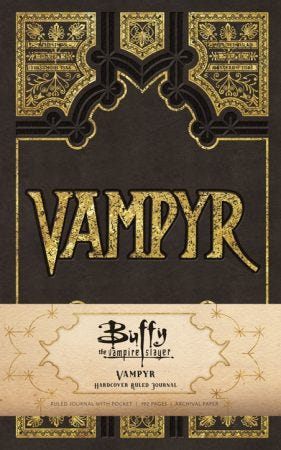
Obviously, I owe some of my success—with Buffy and Angel, with the Witch Season series, etc.—to my own writing abilities. But I also owe a lot of it to Lisa, who was willing to give a new guy a shot. And of course, to the many readers and fans who’ve bought and read and recommended my books over the years. It’s been an incredible ride, a dream career, and I thank you all. Next time, maybe I’ll write about writing Angel comics.
In comments, please tell us about a woman who was influential in your career or your life in general. Moms and sisters and daughters count!